Skip to content
Back to the homepage

The Lab. Try it before anyone promises it.

For engineers who want to look closer. Everything here says exactly what it is — a simulation in your browser, hardware being built, or a plan.

LAB-01 · A digital twin you can break

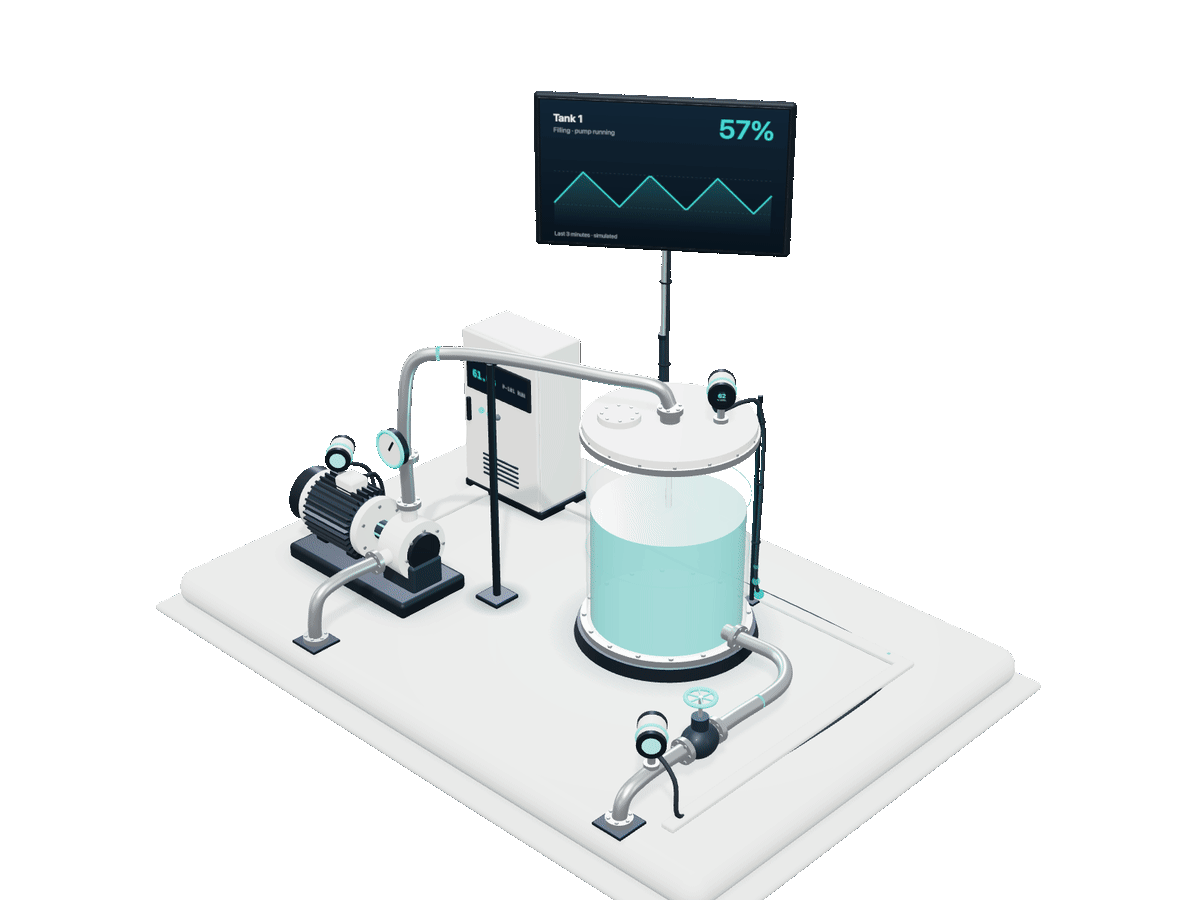
A tank, pump, sensors, controller and operator screen, simulated live — start it, then pull the network cable or cut a sensor wire.

  • PLCControllerStoppedStopped
  • LinkNetworkOKConnected
  • ScreenScreenLiveLive

Digital twin · simulated in your browser at 4× speed · no real equipment or data

What is happening

Everything is stopped.

A tank, a pump, four sensors, a controller and an operator screen — all simulated in your browser. Start the system to see them work together.

Try a scenario

Scenarios done: 0 of 4.
SupplyPumpoffPT1030.20 barTT10424.0 °CTank · 500 L52.0%STOP 70START 40LAL 15LT10112.32 mAsensor signalFT1020 L/minTo consumer · normal demand

Field signals · read by the controller

LT-101
Tank level
52.0 %
FT-102
Outlet flow
0 L/min
PT-103
Pump discharge
0.20 bar
TT-104
Motor temperature
24.0 °C
LT-101
Loop current (4–20 mA)
12.32 mA
PLC mode
stopped
P-101
off
Missed polls
0

LAB-02 · runs in your browser

What a motor's vibration can tell you.

A small motor, modelled in your browser. A vibration sensor records its acceleration over time (left); a Fourier transform splits the same signal into frequencies (right). Running normally, the energy sits at the rotation speed. The anomalous model adds the kind of change wear can cause — short impacts and new high-frequency content — and the figures underneath show how the numbers move.

Synthetic data · concept demonstration · not a diagnosis

Every trace and number in this experiment is generated in your browser from a model of a small motor. Its changes are generic and do not identify a specific mechanical fault. No hardware data is shown.

In development · EXP-001

On the bench: vibration acquisition on a small motor.

Real hardware, in progress. This is a build log, not a result. ESP32 and an accelerometer on a small electric motor. No hardware results are published yet.

Goal
Measure the vibration of a small electric motor with an ESP32 and an accelerometer, and compare the real signals with the synthetic model of LAB-02.
Done so far
  • Hardware chosen: an ESP32 microcontroller and an accelerometer, on a small electric motor.
  • Analysis defined and tested on synthetic data (LAB-02): windowing, FFT, RMS, crest factor and high-frequency power.
Next (planned)
  1. 01Mount the sensor and record the first real signals.
  2. 02Compare the real spectra with the synthetic model, and state where they differ.
  3. 03Publish the method, the data and its limits — including what does not work.

Roadmap · planned

  • PLN-01Modbus TCP communication demonstrationA documented register map between a controller and a supervisory client, including timeout behaviour.Planned
  • PLN-02Industrial control and monitoring prototypeA small physical process under PLC-style control, with an HMI, alarms and an event history.Planned
  • PLN-03Automation test benchA reusable bench for exercising I/O, sequences and fault cases before equipment meets the field.Planned

What these experiments demonstrate.

Have a machine or a measurement in mind? A first project is small, specific and tested.

Discuss a project